
Imagine buying a cheap plastic laptop designed for children that constantly lags, and can’t open more than a dozen tabs without packing a sad. Now imagine you’re a writer, and this hunk o’ junk is the primary tool you use for several hours each and every day. Imagine how dumb you’d have to be to endure that much frustration and wasted time for the sake of a couple hundred bucks.
(I don’t have to imagine, because I was that dumb guy.)
After hitting peak pathological penny-pinching circa 2016, I’ve slowly but surely learned which things are worth paying money for. Sometimes, a lot of money. At first I found it hard to reconcile my growing taste for nice things with the frugal ethos. But there isn’t necessarily a contradiction here.
The general wisdom is that in the long run, buying quality stuff might actually save a lot of money.
The go-to explanation of this comes one of my favourite authors, the late and great Terry Pratchett. Here’s his reluctant hero Sam Vimes, a grizzled and working class policeman:
A really good pair of leather boots cost fifty dollars. But an affordable pair of boots, which were sort of OK for a season or two and then leaked like hell when the cardboard gave out, cost about ten dollars. Those were the kind of boots Vimes always bought, and wore until the soles were so thin that he could tell where he was in Ankh-Morpork on a foggy night by the feel of the cobbles.
But the thing was that good boots lasted for years and years. A man who could afford fifty dollars had a pair of boots that’d still be keeping his feet dry in ten years’ time, while the poor man who could only afford cheap boots would have spent a hundred dollars on boots in the same time - and would still have wet feet.
This was the Captain Samuel Vimes ‘Boots’ theory of socioeconomic unfairness.
This is cute and insightful, but also… not really true? Sometimes it makes sense to buy the good boots. But most of the time, it’s far more cost-effective to go for the equivalent of the crappy cardboard soles. Even for rich people.
For this latest instalment of ‘barbells in everything’, I hereby propose the barbell strategy for stuff: buy the very best-in-class for a small set of items, buy the cheapest possible version of everything else, and avoid the middle ground altogether.
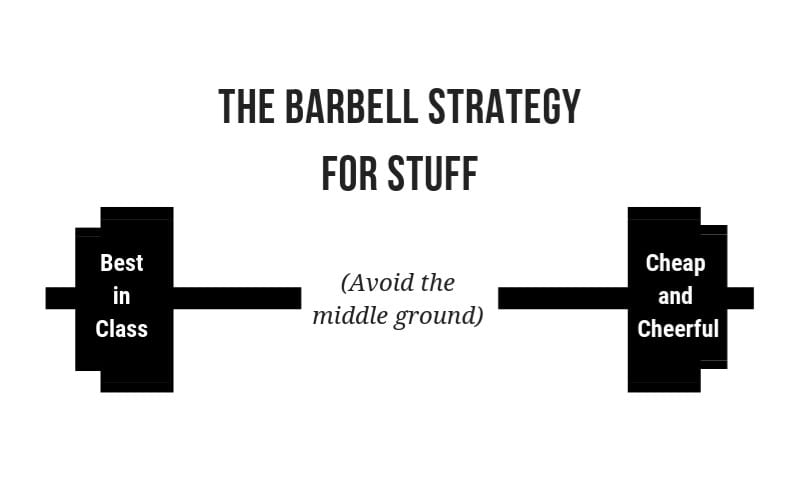
What sort of items clusters on the ‘best in class’ end of the barbell? I can think of two general guiding principles:
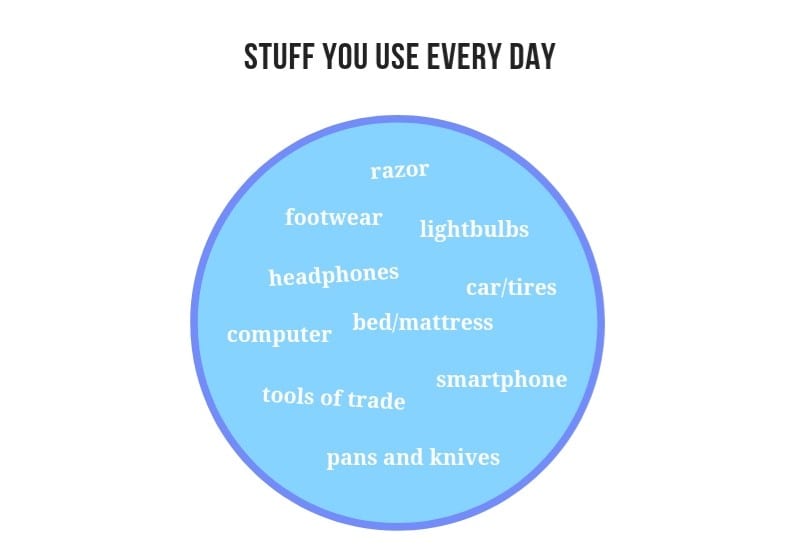
1. Buying Quality: Things You Use Every Day
Laptops, desks, phones, keyboards, or whatever tools of the trade you use daily. This applies to leisure time, too. As soon as I splashed out on a pair of good bluetooth headphones, I kicked myself for not doing so years ago. And obviously, sleep: you spend a third of your life in bed, so don’t settle for a crappy mattress. If you cook every day, invest in really good knives, and cast iron pans. And so on:
2. Buying Quality: Things With a Risk of Ruin
It seems like a really bad idea to pinch pennies on helmets or protective gear, bald tires, cut-price condoms, or anything else that could be ruinous to your life and liberty. If this wasn’t specifically about physical stuff, I’d include things like health insurance and nutrition here too.
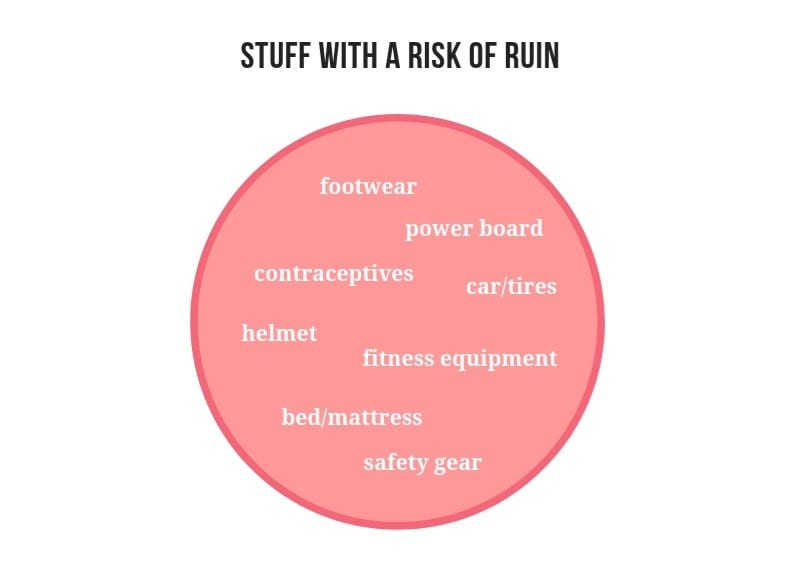
The reason Sam Vimes’ boots are such a great (but unrepresentative) example is that they fit both categories: you probably wear shoes every day, and crappy footwear can screw up your health in all sorts of fascinating ways. If you bring the two circles together in a Venn diagram, it’s worth paying special attention to the things in the middle:
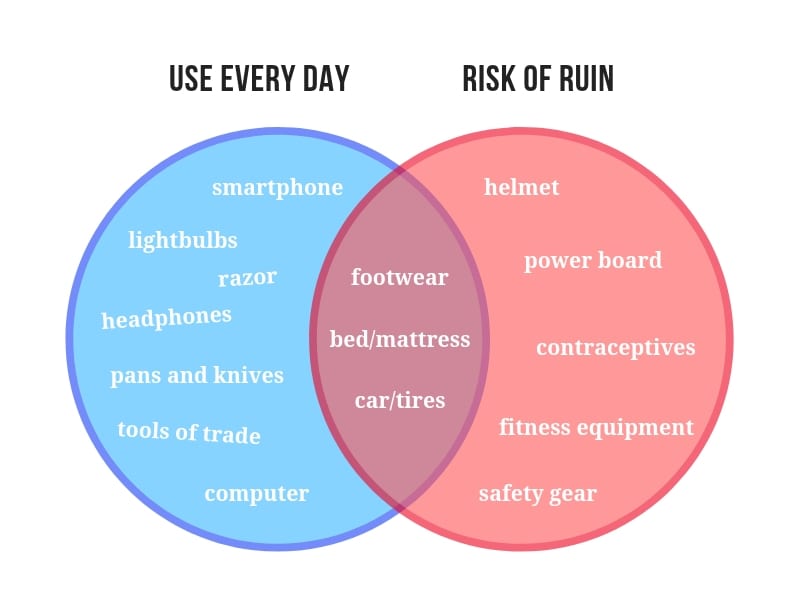
…which just so happens to perfectly match the old-timey advice to ‘invest in things which come between you and the ground’. Neat!
Cheap is Cheerful
What goes on the other end of the barbell? I’d argue ‘basically everything else’. As a general rule, owning expensive stuff is a pain in the butt.
There’s the upfront cost: you have to stump up more cash (duh). But there are also ongoing costs: depreciation, maintenance, security, maybe even insurance. You’ve invested in something, and that comes with responsibilities. These mental costs tend to be less obvious.
I once met an American backpacker who carried her $400 designer boots everywhere she went, because she was too scared to leave them on the front porch of the hostel like everyone else. In the same fashion: you can hardly leave your expensive racing bike leaning up outside the 7-11 while you pop in for a cheese toasted sandwich.
There’s a very real sense in which people with a lot of expensive possessions forge the chains that bind them. Imagine the constant stress of having to think about security, making sure the insurance policies are up to date, the nerves of loaning something to a friend or neighbour, the upkeep on your big empty house. Cheap is cheerful.
Only Fools Rush in
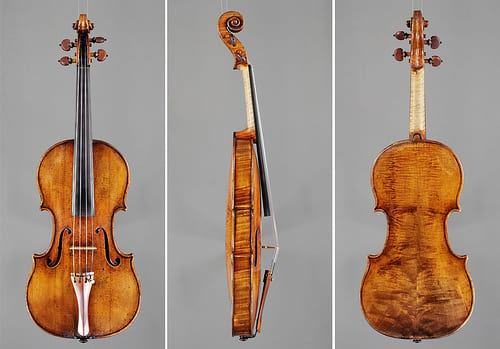
probably don’t go straight for the stradivarius
If it’s not obvious whether you should buy quality or the el cheapo version, start on the el cheapo end. If you never have any problems, great! You just saved a whole lot of money. If it breaks, or it becomes clear it’s not fit for purpose, you can upgrade without having wasted much cash.
Another rule of thumb along these lines: be wary of buying anything ‘for life’ if it’s hobby-related or whimsical. As discussed in Goals Gone Wild, we’re pretty bad at predicting what our future-selves will enjoy. Preferences change over time, sometimes dramatically. This is why storage units and garages often end up as mausoleums to long-forgotten fitness fads, musical instruments, snowboarding gear, and other lifestyle clutter.
No matter how strong your burst of initial enthusiasm, try not to rush in. Get the entry-level version, preferably secondhand, and see if the passion persists. Once you get skilled enough to actually benefit from having triple-forged titanium alloy frames or whatever, go ahead and splash out.
Rags and Riches
Some classes of items are worth spending a lot of money on. Others aren’t. But there are also situations where you might own the same type of item on both ends of the barbell.
For example, I have a core kit of expensive travel clothes and accessories: a really good pack, boots, merino wool base layers, some technical clothing. But when I arrive in a new city or country, I usually buy a few extra bits and pieces to supplement my wardrobe.
I put very little effort or expense into this revolving cast of minor characters. If I spill food on them, or they get torn, or someone pinches them off the clothesline, who cares? Of course, that doesn’t mean I’m cavalier about it. I usually try to buy this kind of stuff from second hand stores to avoid waste, then donate it back again when I leave.
Rags or riches: nothing in between. The dreaded middle ground is the realm of brand names, in which the price decouples from the actual quality. I’ll happily spend $60 on a merino wool shirt, or $3 on a cotton tee. But I’m never going to spend $30 on a cotton tee, because it’s not going to last 10 times as long as the el cheapo one. Chances are both tees were made in the same shitty factories- the only difference being, one of them has a cool logo.
I can imagine similar barbells for kitchen utensils, tools, sports equipment, and various hobbies.
Let me know what I’ve missed on the Venn diagram, and any other examples of barbell strategies for stuff!


22 Comments
Comments are archived from the original site. To respond, get in touch via the contact page.
Show 1 reply Hide reply
Show 1 reply Hide reply
Show 1 reply Hide reply
Show 1 reply Hide reply
Show 1 reply Hide reply
Show 1 reply Hide reply
Show 2 replies Hide replies
Show 1 reply Hide reply
Show 1 reply Hide reply
Show 1 reply Hide reply