
tl;dr: Went about as expected, i.e. no obvious effects, with a few mildly interesting observations. Publishing this mainly to push back against the file-drawer effect, and to highlight an example of an experiment which has both a positive expected value and a ~95 per cent chance of failure.
this is your brain on keto
What is the ketogenic diet good for? At the time of writing, the answer is ‘reducing epileptic seizures, probably’. Every other potential benefit has a big old question mark hanging over it. Until recently, I mentally categorised keto as just another trendy and stupidly-restrictive diet.
Then I realised I was thinking about it wrong. A small minority of people report incredible results: either it cures whatever ailment is plaguing them, or it gives them a deep sense of wellbeing that lets them fully embody their authentic self and tear through life like a pure focused laser beam of energy and agency, etc.
I myself have a few ailments I wouldn’t mind curing, mostly of the autoimmune variety, and of course I would like the laser beam thing too.
Even if there’s only a very small chance of getting those kind of results, it totally makes sense to try it out.1 This is a textbook case of the kind of self-experiment I love: capped downside and unbounded upside. The cost is minimal—basically a month of eating in a goofy way—with the potential for life-changing benefits if it does happen to work.
The Keto Experiment Protocol
Keto = eat zero carbs, or as close to zero as possible. The idea is to switch from primarily burning carbs for fuel, to primarily burning fat—either dietary fat, or your own bodyfat.
Some people do keto to lose weight, some do it for health reasons, and some do it to improve energy or mood.
I don’t care about weight loss, so I ate at a small surplus, shooting for ~3200 calories a day. Of that, my goal was to take in fewer than 50g of net carbs,2 and ideally closer to 25g. I didn’t set any limits on protein intake, typically eating about 120-160g a day. Then the rest of my calories came from fat. So much fat. Great big mountains of fat!
I tracked my macros and calories using an app called Macrofactor, which I highly recommend. It was challenging to get enough calories to begin with, but then I settled into a few repetitive meals:
- Breakfast: Keto porridge made with almond meal, flaxseed, chia, heavy cream, whey isolate powder. Topped with walnuts or raspberries.
- Lunch: Four-egg omelette with lots of cheese, mushrooms, capsicum. Topped with avocado and more cheese.
- Dinner: Oily fish with a ton of leafy greens or brassicas cooked in oil, parmesan.
- Shake: Heavy cream, frozen strawberries, whey isolate powder.
- Snacks: Macadamias, almonds, keto cookies, quest bars.
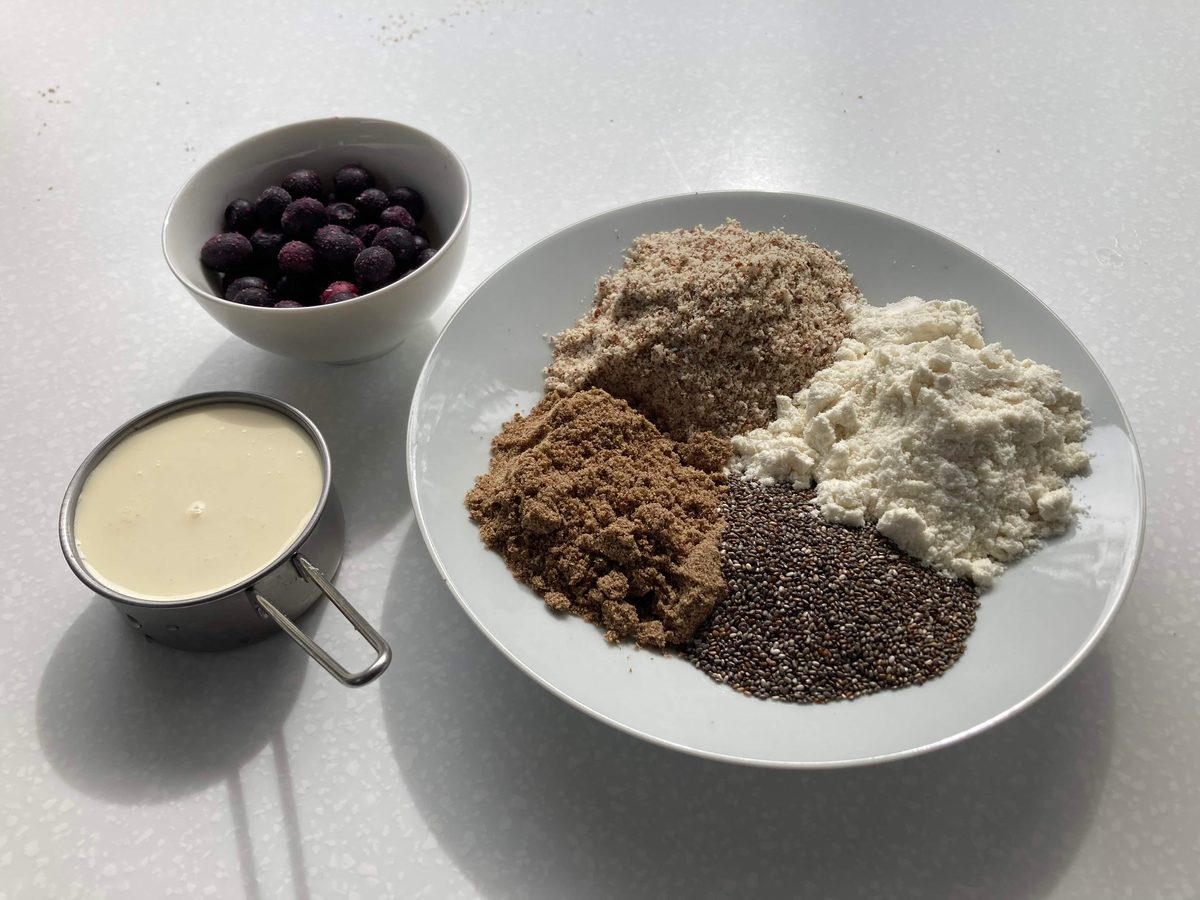
A 1500 calorie breakfast that doesn’t send me spiralling into a food coma? Sign me up.
The Dreaded Keto Flu
Ketosis is freaky. We’re born with a whole separate metabolic system which lies dormant for decades, or sometimes our entire lives. No surprise there are a few cobwebs to blow out when we’re trying to get the backup engine running cleanly.
The transition into ketosis often involves headaches, brain fog, lethargy, etc, which generally goes by the name of ‘keto flu’.
In the first week, my energy levels crashed a couple of times, to the point where I fell asleep on the couch at 3pm. I did not feel like a laser beam of focused energy.
But I managed to avoid the keto flu. On reflection, this is probably because I’ve done quite a few extended fasts, which also puts the body into ketosis. My first fasts were definitely unpleasant. Direct quote from a journal entry at the time:
Lay down on the bed but couldn’t drift off. Proceeded to have a nightmare of a night, with nausea, insomnia, and fleeting madness. At one point I must have slept for a few hours, without being aware of it. Drank some more water and finally managed to sleep again.
Now I guess my body is used to switching into ketosis and can do it pretty smoothly, but that wasn’t always the case.3 To the extent that you get the full-blown keto flu, that weighs much more heavily on the ‘downside cost’ side of the equation.
How Hard is it to Stick to the Keto Diet?
If you control the food environment it’s surprisingly OK. My girlfriend joined me in the experiment, which made life a lot easier, both in terms of shared cooking and not having delicious carbs in the house. We brought our own food to a family gathering, and hosted a dinner party where the guests didn’t realise everything was keto. Not bad.
On the other hand, going out for dinner was pretty much off the table. I didn’t have any travel during the month, but that would have been pretty niggly too, and probably I would have compromised in some way.
If I didn’t eat fish, keto would have been harder, but still doable. If I were a strict vegetarian, i.e. no eggs or dairy, it would have been impossible. Eggs, cheese, cream, and whey were a central part of my diet.
The repetitive meals did start getting a little stale, even for someone like me who loves that kind of thing. This is good if your goal is weight loss, but it wasn’t ideal for my purposes. When you’re trying to smash a ton of calories, a mixture of carbs and fats is definitely easier than fats alone.
What Happens if You Drop Out of Ketosis?
First you should know whether you’re in ketosis in the first place. This means checking your levels of ketone bodies. You can either pee on a stick, measure your breath (which should smell like nail polish remover) or take a blood test.
But as far as I can tell, these tests are unnecessary, or in some cases bullshit. If you’re only eating trace carbs over a period of days or weeks, you’re either in ketosis or you’re dead. Nevermind what the piss-stick tells you.
What about minor diet violations? Let’s say you eat 20g of carbs above the level that would keep you in ketosis. That’s 80 calories, or about 4% of a day’s energy expenditure. So in the worst case, maybe you get bumped out of ketosis for an hour. Then what happens? The carbs are gone, there’s nothing else to metabolise but fat, so you go back into ketosis.
Maybe there’s some mechanistic thing I’m missing here, but basically, as long as you’re strictly avoiding non-fibrous carbs, you should be good. (If you’re regularly having ‘cheat days’ and don’t track your macros properly, not so much.)
Results of the Keto Experiment
We’re looking for big, obvious results, or nothing at all: I don’t think it’s worth running keto just to pick up marginal improvements, especially considering they might be random noise or placebo.
On the mental side of things I didn’t track any concrete metrics, so this is purely vibes-based. And the results were…a big fat nothing! I guess I had less post-meal sleepiness? But the changes were nowhere near dramatic enough to write home about.
My autoimmune situation was unchanged. Mildly disappointing, but I knew it was a long shot. Sleep was worse at first, then it normalised. I didn’t track bloodwork so don’t have any more data than that.
Physically, I felt a little deflated with muscles starved of glycogen, but had no problem completing my workouts, and continued gaining strength roughly as planned. My girlfriend was able to do 3km swims without any problems, which was a lot more surprising.
Would I do the Keto Diet Again?
Despite the underwhelming results, I weirdly enjoyed this experiment—it got me cooking more creatively4, it accidentally nudged me into more healthy eating e.g. a shitload of greens and Omega-3s, and it eliminated my cravings for sugar, which I’d noticed becoming a bad habit after meals.
There is a meme in the keto community that it takes some time to become “fat adapted”, as distinct from merely entering ketosis, and that this period might be as long as three months. The concept is totally nebulous, but keto advocates might say I stopped too soon to realise the true benefits.
What if they’re right? I highly doubt it, but I’m kind of tempted to do this again. Next time I’d do it during a phase where I’m trying to lose weight, where I think it’ll be a real weapon—I can get all the satiety benefits, and it’ll also be easier to sustain for a long time, since I’ll be eating restrictively anyway.
In conclusion: keto was definitely worth a try. I’ve been slipping on the self-experimentation front lately, and it feels good to get back after it.
If you have e.g. fatigue, obesity, brain-fog, or autoimmune conditions and you’ve exhausted all the normal treatment options, the expected value of these kind of random experiments is a lot higher: merely getting back to a baseline level of health and energy is a huge win.
If your health is already normal, then the equation is less compelling. Still, as far as experiments go, you could do a lot worse.
Notes
Footnotes
-
Conditional on some of those glowing endorsements coming from people I trust, and at least some plausible mechanistic pathway. Otherwise this argument for trying stuff would be way too general: it’s easy to find people who swear by all kinds of quackery. ↩
-
‘Net’ means excluding carbs from fibre. This makes it easier to eat veggies and even some fruit without going over the limit: 100g of raspberries has 6.5 grams of fibre and 5 grams of net carbs, for example. ↩
-
I also made sure to eat a ton of salt, because I suspect a lot of keto/fasting problems are dehydration in disguise (including that gnarly night from the journal, which happened after I’d hiked ~10km without taking extra electrolytes). Each gram of glycogen is bound to three or four grams of water, which all gets flushed out in the first few days—this is what causes the rapid ‘weight loss’ that people get so excited about. ↩
-
Keto cookbooks remind me of the rules-lawyering shenanigans that observant Jews use to get around Shabbat restrictions. There’s a keto-fied version of every ‘junk’ food you can imagine: I tried cauliflower pizza, zero-carb cheesecake, and almond-flour cookies, among other Frankenstein-like creations. ↩



17 Comments
Comments are archived from the original site. To respond, get in touch via the contact page.
Show 1 reply Hide reply
Show 1 reply Hide reply
Show 1 reply Hide reply
Show 1 reply Hide reply
Show 1 reply Hide reply
Show 1 reply Hide reply
Show 1 reply Hide reply
Show 1 reply Hide reply