

If the world itself is a horror then there is nothing to fix and the only thing you could be protected from would be the contemplation of it.
— Cormac McCarthy
IMAGINE THE TREPIDATION when you’ve read pretty much an author’s entire body of work, trying to pace yourself like a child with a gobstopper to make it last as long as possible, but inevitably all too soon you find clutched in your sticky fingers the very last words he will ever write: The Passenger and Stella Maris, companion novels published when the cancer inside his body was only months away from concluding its black business.
Fans have been waiting 16 years for this. The pressure is on.
Now up the stakes again: in this last-ditch diptych, your crusty 89-year-old literary grandaddy completely changes tack, abandoning his infamous lack of interiority to hold forth on the biggest philosophical and scientific questions of our age—solipsism, platonism, quantum mechanics, linguistics, you name it. Nothing is off limits. A man who has made a career of darkly hinting at gnostic fragments of truth buried within dreams and archetypes has, at the end of it all, begun to tell you what he really thinks.
In previous works the philosophy was in the background. Now names drop like flies, thick and fast: Kant, Wittgenstein, von Neumann, Grothendieck, Dirac, Feynman. A buzzing horde of the great mathematicians, physicists, and philosophers of the 19th and 20th centuries droning and stinging and crawling all over the page.
The fear: what if your main man McCarthy reveals himself to be a pseud at the very end?
As a literary intellectual, his position was more or less unassailable. They anointed him with the MacArthur grant back in 1981, he never gave you any reason to doubt his genius and now he is safely dead. That’s a lock on immortality. But no, he had to make one last sally, stepping out of his lane to straddle C.P. Snow’s two cultures; from the sphere of literary intellectuals where a little artful bullshit is not only permitted but encouraged to the cold hard crystalline realm of the shape rotators. Cormac, you absolute mad lad.
So did he pull it off?
A skeletal plot summary

The Passenger is a mystery centred on Bobby Western, a former physicist whose father worked on the atomic bomb.
Bobby has a big problem in that he’s in love with his sister. An even bigger problem is that she’s dead.
(This is not a spoiler.)
The main distraction from this problem comes when Bobby—who now works as a salvage diver—stumbles on a downed plane in fishy circumstances. The black box is missing, and it later seems that so is a passenger, despite the fact that all the other bodies are still strapped in their seats and the divers had to cut their way into the fuselage. Bobby is pursued by shadowy figures, some of them feds, who think he took something from the plane or knows where the missing passenger is. His apartment is ransacked; his bank accounts are frozen. Bobby is forced to go on the lam.
I don’t think it’s a spoiler to say that none of that stuff matters and the mystery is never solved, because the moment you understand what the book is doing you realise that of course it won’t be.1
The plane mystery provides us with the skeleton of a plot, and we get some classic McCarthy descriptions of rain-swept beaches and dingy motels, but the real meat of The Passenger is in the long conversations between Bobby and his band of intellectual misfits, interleaved with dialogues between his sister Alicia—a brilliant but tortured mathematician—and her menagerie of hallucinated companions.2
Then Stella Maris abandons all pretences: the entire book is philosophical conversations between Alicia and her shrink in the period leading up to her suicide, with no descriptions or anything that resembles a plot beat.
I explain this so you won’t be confused when I ignore the plot throughout the rest of this review.
The problem of trying to write characters who are smarter than you
If you confuse the beliefs of a character in a book with the author’s own personal convictions then you have failed media literacy 101. Nabokov has a great deal in common with his infamous creation Humbert Humbert—they are both snooty emigrés with a love of wordplay and a fancy prose style, etc—but it is very important that they don’t share certain other predilections.
At the risk of embarrassing myself, I am going to argue that the characters of The Passenger and Stella Maris really do give us direct insights into McCarthy’s own worldview. In some cases they act as literal mouthpieces: Alicia not only holds forth on the Kekulé problem but refers to it by name.
More generally, there is a bind in trying to write characters who are smarter than you, which is that it pretty much forces you to show your hand. Alicia is a genius by any definition—a brilliant mathematician at a young age, incredibly well read, a connoisseur of rare violins—and Bobby is no slouch himself. To write these characters convincingly you have to model what a very smart person might think about, say Wittgenstein’s turn, which will necessarily be the best idea you personally can wring out of your modest endowment of gray matter. There is always the temptation to parrot something a smarter person has said, but you still have to be able to riff on it smoothly enough that you don’t inadvertently reveal you have no idea what you’re talking about.3
For more on this, see my book club’s discussion of Ted Chiang’s Understand, where we talk about the problem of trying to convincingly portray superintelligence:
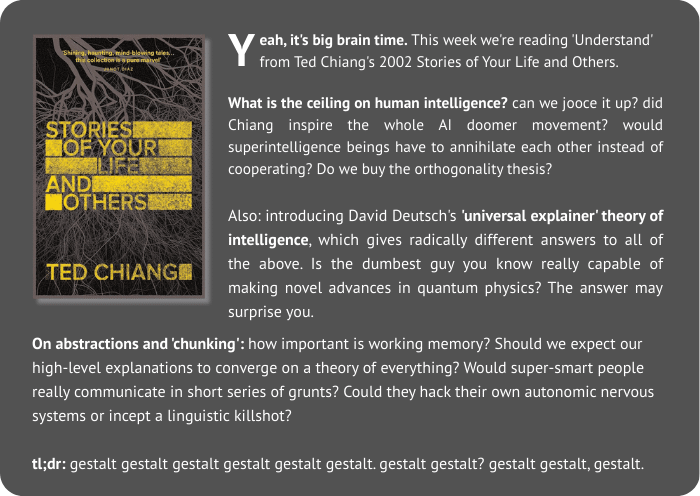
In order to pull off this trick, you only have to be smarter than the reader—in this case, me. So the bar has not been set high, but I can report that whenever I had some knowledge of the subjects McCarthy was talking about, it held up fine, and whenever I didn’t, it at least passed the sniff test.
In fact I’ll go out on a limb and say my boy is the real deal. He has done the reading. He has thought the thoughts. McCarthy might be the only ‘literary’ author I’ve come across who also has an impressive command of the hard sciences and analytic philosophy (I’m sure there are others, tell me who they are!).
However. What didn’t pass the sniff test is the way these conversations unfold.
Squeezing stemlords through the wordcel wringer
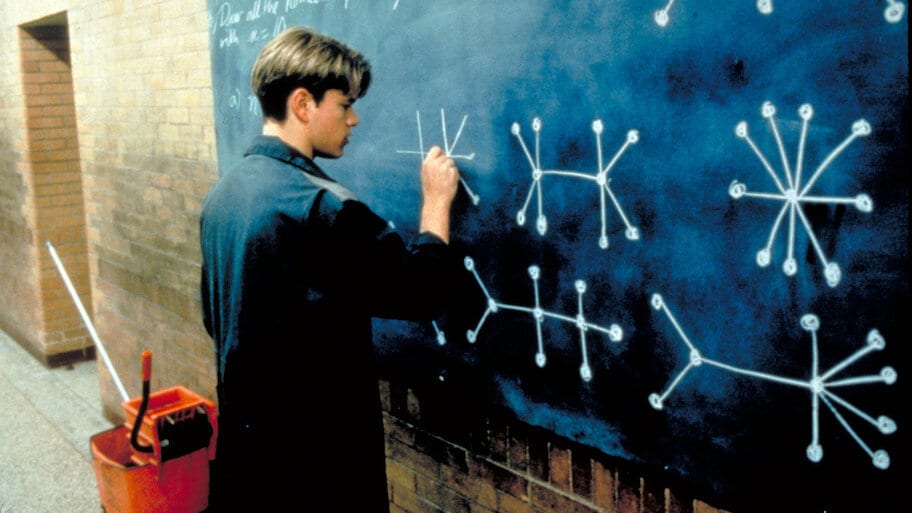
The intellectual underworld of The Passenger consists of barflies and private investigators and transexual prostitutes and oil-rig workers and alcoholics living in doublewides who are all blue-collar or a little rough around the edges but have off-the-charts verbal acuity/can solve differential equations in their heads.
In other words, Good Will Hunting-types.
There are surface variations in backstories and appearances, but at the core all the characters have the same psychological carriage. That goes doubly for Bobby and Alicia, and while it’s maybe not that surprising for siblings to be so similar, in the end it feels like fragments of one person—in this case, I claim, Cormac McCarthy—talking to himself.
This would be strange enough, but these intellectual dialogues also bear very little resemblance to the way in which STEM dorks talk. If you have some provocative claim about, say, whether mathematics can find a non-self-referential foundation, you can’t just dangle it out there and move the conversation on!
This is a red rag to a bull: your interlocutor wants to get clarity on what you’re saying and not saying, define terms, probe for weaknesses, try to find out whether it’s genuinely interesting or can be dismissed. If it’s interesting then there’s a pretty high chance someone is getting out a whiteboard.
Obviously McCarthy knows this. He was the only non-scientist fellow at the Santa Fe Institute, and talks fondly of e.g. legendary 10-hour lunches with the physicist George Zweig.4
The problem is that 10-hour lunches and heated whiteboard discussions are not what you’d call cinematic.
So instead we get boffins written in the style of literary intellectuals: a neat little insight, a showy soliloquy, a quip, and then the glide-away—don’t be tiresome, darling—before anyone can sink their teeth into a claim. This is the flirtatious pitter-patter of courtesans, not the grinding gears-level dialectic of philosophers or scientists.
I’m not saying it’s a bad thing. I love Good Will Hunting. But the net effect is being covered with gentle little butterfly-kisses of ideas. As soon as your special topic of interest comes up, you just about have time to do the Leo pointing meme, and then it’s gone.
And it’s still a hell of a fun ride. These books are packed full of weird factoids, interesting stories and theories—the truth behind the JFK assassination, why babies are so angry, whether music is transcendent—along with the occasional set-piece that I will never forget, like Alicia’s nightmare fuel account of the exact physiological changes you would experience if you attempt to drown yourself in a deep lake (As you descend, your lungs will start to shrivel. At a thousand feet they’ll be about the size of tennisballs…)
But ultimately you’re looking at a mosaic of interesting tit-bits. Since there isn’t much in the way of plot, and the characterisation is unusually uniform, it is very important that the fragments add up to more than the sum of their parts. What’s the big picture here?
The Cormac McCarthy metaphysical horror show

McCarthy’s early work takes place in the blighted landscapes of Appalachia and Tennessee, exploring the social and moral rot that drives people to madness and despair.
I don’t think it’s too mean to say that some of this stuff is basically fancy Stephen King. You have your serial killers, corpse-snatching, infanticide. Things that go bump in the night.
As he gets further into his career, the violence is a constant—in fact, Blood Meridian is far and away the most gruesome book in the catalogue5—but he also introduces the first creeping tendrils of what is best described as metaphysical horror.
The blackpill of Blood Meridian is that everything is overdetermined to the point of inevitability. There are forces so ancient and so deep in us that we will not escape them. Rivers of blood and 300,000 year old skulls that show signs of having been scalped. Even our great triumph of civilisation is nothing but a flimsy artifice, redirecting the grinding machinery of the blind idiot god of evolution towards Molochian capitalism and manifest destiny and a relentless march westward until you run out of country.
(The judge is dancing, dancing, he says he will never die.)
The same undercurrent of fatalistic bleakness runs through No Country for Old Men. Moss has every chance to walk away but just can’t bring himself to do it; Chigurh’s coin toss is a kind of ritualised theatre for what was already inevitable.
In The Passenger and Stella Maris, McCarthy pushes the idea as far as it will go. For the first time in his career, he shies away from explicit violence, focusing instead on metaphysical horror in its naked form: what new fears might you discover if you delve too deeply into the nature of reality itself?
Solipsism and the void

She said that the hallucinations had begun when she was twelve. At the onset of menses, she said, quoting from the literature. Watching them write on their pads. Reality didnt really much seem to be their subject and they would listen to her comments and then move on. That the search for its definition was inexorably buried in and subject to the definition it sought. Or that the world’s reality could not be a category among others therein contained. In any case she never referred to them as hallucinations.
—Stella Maris
If McCarthy’s earlier works are obsessed with determinism, these final novels examine the horrors of indeterminism.
This sounds like a contradiction, but I think we can square it. What determinism and indeterminism have in common is that they rob you of agency: one says that the world will do with you what it will; the other says that if you try to set your feet there is nothing there to brace against.
This is the blackpill of The Passenger and Stella Maris. There is no way to verify base reality, there is no secure footing for the greatest edifice humanity has ever produced, and even our most brilliant minds fail to substantiate anything.
McCarthy is especially interested in mathematicians, who have spent the last two centuries getting rugged over and over again: set-theoretic paradoxes, model relativity, Gödelian incompleteness, undecidability limits, the quantum measurement problem. If anything in life is certain, you’d think it’s 1 + 1 = 2! Instead, the whole project turns out to plagued with inconsistencies that can’t be grounded without getting stuck in self-referential loops. Even the hardest of the hard sciences is doomed to forever pull itself up by its bootstraps.
OK so what, you ask? Who could possibly get worked up about this stuff?
But the business of poking at the foundations of reality has in fact been frequently torturous and psychologically destabilising for some of the best brains in the business:
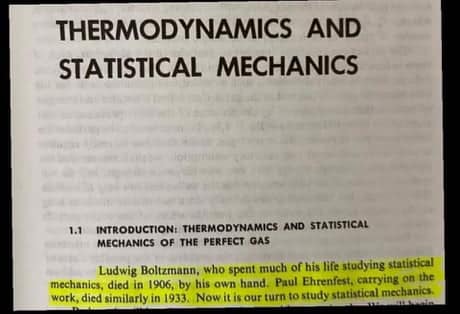
the greatest textbook introduction of all time
Besides Boltzmann and Ehrenfest, McCarthy gives us Gödel, Bertrand Russell, and various others as examples of brilliant people who have experienced anxiety to mania to full-on mental breakdown in grappling with the implications of their life’s work.
All of which is designed to demonstrate that his own creation, Alicia Western, is in very good standing.
But poor Alicia gets a double dose of instability. Not only is she driven to despair by the lack of foundations in maths, she is also unmoored from more quotidian reality, in that e.g. she receives regular visits from a performing troupe of freaks and spends long spells in psychiatric hospitals.
This second strain of horror comes from the problem of solipsism—that outside the bony prison of your own mind, you have no way of knowing for sure what is real. Perhaps you’re not losing any sleep over questions such as ‘are we living in the matrix?’, but you should be terrified by the thought that if and when you begin to lose your mind, you may not even be aware of it: the texture of your internal experience will feel exactly as ‘real’ as it always did.6
And so Alicia politely adopts the point of view of her interrogators, but never actually concedes that her visitors are imaginary. From her perspective they’re exactly as real as anything else, and the fact they vanish when she takes certain drugs proves nothing. Psychiatry lacks mechanistic explanations. It’s a black-box science. If a certain chemical reliably cuts off a certain type of experience, that doesn’t ground a claim that you’re now in ‘base reality’. We don’t have any base reality to anchor back to!
If determinism is a prison, then indeterminacy is a void. In either case, there is no final reason for why the world should be otherwise.
Escaping the spiral of solipsism
Alicia is determined to die. She has thought it through in excruciating detail, and she’s way too smart to have her mind changed by a shrink or by anyone else.
And yet…I can’t help but thinking that I could have saved her.
Or rather: Karl Popper could have.
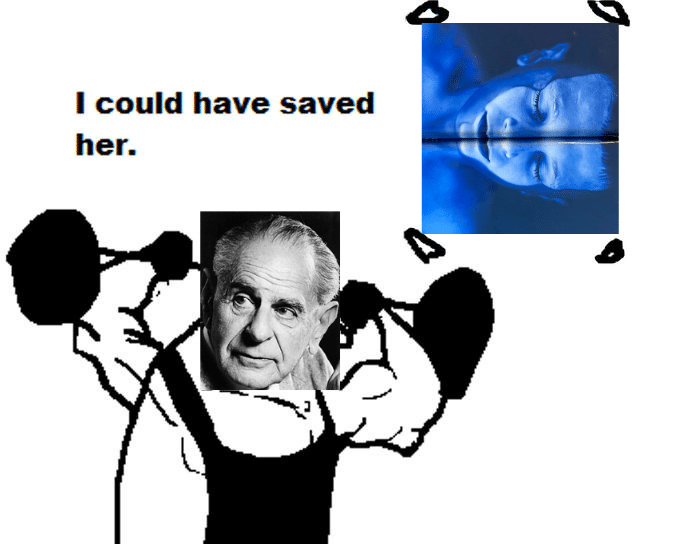
With a who’s who of 20th century philosophy littered throughout these pages, Popper is conspicuous by his absence. It’s such a strange omission that I almost want to say it’s a plot hole—Alicia is a keen philosopher who reads multiple books a day! the book is set during the peak of Popper’s fame! there’s no way she wouldn’t have engaged with his work!—but to be fair, it would have ruined the drama when she immediately understood that his epistemology gave her a lifeline.
To take the Popper pill is to acknowledge that any attempt to ‘justify’ our knowledge is a dead end. Once you accept the idea of fallibilism, you can cheerfully construct theories about the world, criticising and pruning the bad ones, and trust that the process itself will steer you closer and closer to base reality. You’ll never know for sure if you’re right, but there’s nothing disheartening about that. It has always been this way and there’s no other way it could be.
So the horror doesn’t fully land for me.7
But reading these books still felt like a punch in the gut, because it finally forced me to confront something that has long been lurking in my subconscious.
I’m in my mid-thirties, and still an inveterate wordcel. Trying to understand the world is what brings me the greatest joy in life, but my understanding will forever be limited by the fact that I never got much further than high school maths. No matter how many popular books I read about infinities, quantum physics, cosmology, they only give me the illusion of understanding. What I am really seeing is shadows dancing on the wall.
McCarthy is an especially skilful puppeteer, but he had to grapple with the same realisation. Here’s Alicia:
There is a wall there, and if you dont understand numbers you wont even see the wall.
To a mathematician I’m blind, or lacking some important sense. Maybe I could learn to develop this faculty but there are only so many hours in the day and this is the path I have chosen. Instead I have to accept that I am doomed to have a fundamentally shallower understanding of the world than I might have had in other lives. I do feel sad about that. Maybe even angry: it feels like an affront to my obsession with trying to catalogue the world. Whatever in creation exists without my knowledge exists without my consent! But I’m not going to kill myself.

The Passenger & Stella Maris are available on Amazon or at all good booksellers.
OVER IN BOOK CLUB LAND
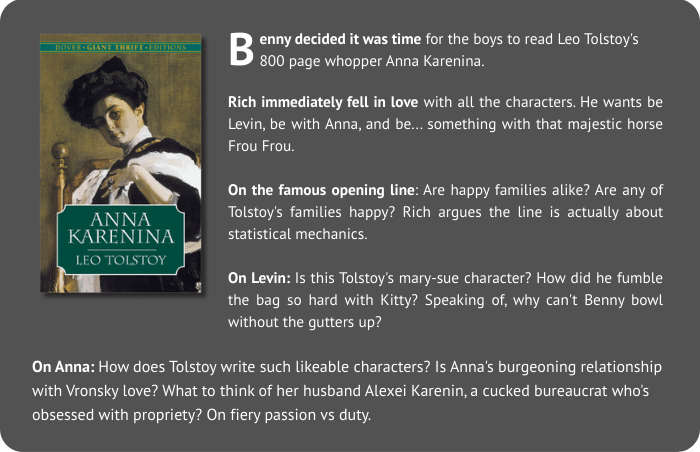
We just wrapped up a three-part series on Tolstoy’s Anna Karenina, which was bittersweet. Here’s the blurb for the first episode, where we fall in love in the book.
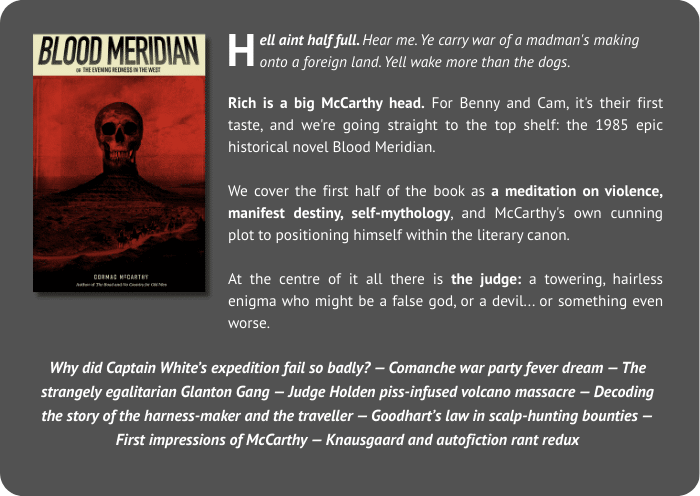
For McCarthy fans: we also did a two-part series on Blood Meridian earlier in the year. It was lots of fun re-reading the book alongside the boys, who were experiencing McCarthy for the first time. Here’s the first part:
Notes
Footnotes
-
I haven’t read any other reviews or analysis of this book cos I wanted to get my first impressions down unpolluted by outside influence. So if there are some lines to draw on the plane and the missing passenger etc by all means clue me in. ↩
-
Interestingly, this is a near-complete inversion of Blood Meridian, in which the protagonist and most other characters say little to nothing, and we have no access to their motivations or inner lives. ↩
-
This is the Igon Value problem coined by Pinker in his brutal takedown of Malcolm Gladwell. ↩
-
The Santa Fe Institute is an interdisciplinary group of researchers working on complexity science; check out this Sean Carroll interview with David Krakauer to get a sense of the problems they’re interested in. It was here that McCarthy published the Kekulé problem (and for which, Krakauer wrote the foreword.) ↩
-
From ‘best books of 2024’: There are two make-or-break factors that will determine whether or you not like Blood Meridian. The first is McCarthy’s idiosyncratic style, which to my taste runs riiight up against the line of purple prose without quite crossing over, but which others might reasonably find to be pretentious or nonsensical. The other make-or-break factor is the violence. It’s relentless and unsparing and genuinely distressing in a way that just won’t be worth it for a lot of people. Personally, I think it’s important to be reminded that the veneer of civilisation is very thin, and must be protected at all costs. In the second half of our book club chat we get into the question of whether humans are intrinsically violent, the kind of coordination mechanisms that have helped us reign it in, and the weirdly refreshing egalitarianism of McCarthy’s nightmare: your ancestors were
shita product of their incentive structures, and so were mine. But there are glimmers of hope (Deutschian knowledge? gnosis?) that let us escape the dance. ↩ -
We talked about this quite a bit in our discussion of Philip K Dick’s Ubik, who is the master of paranoid fiction. Something I can’t stop thinking about is this idea that someone with Alzheimer’s has a perfectly coherent internal subjective experience: they are confused and upset by everyone else’s perceived inconsistencies, and can’t understand why all their loved ones keep e.g. disappearing halfway through conversations. ↩
-
I should also mention that I accidentally overfilled my stomach here. I had just finished reading Maniac by Benjamín Labatut, which not only falls within the same genre of ‘metaphysicial horror’ but has major overlap in characters and stories: Oppenheimer and the bomb, Von Neumann and Gödel, etc. This is a wild coincidence cos I’ve never read anything like this before, and I had no idea that The Passenger/Stella Maris covered similar ground when I pulled them off the shelf. Maniac is great but maybe slightly overplays its hand: von Neumann is a wonderfully bizarre subject but after the sixth vignette of someone telling you how freaky he was it wears thin (I was fascinated to note that McCarthy is clearly not a big fan of Von Neumann: I’d love to know why!). By contrast, Labatut’s earlier, tighter When We Cease to Understand the World is a brilliant little book, weaving together the stories of Grothendieck, Heisenberg, and Schrödinger in a strange web that leaves you wanting more. I highly recommend it. ↩


1 Comment
Comments are archived from the original site. To respond, get in touch via the contact page.