

Here is a transcript of a typical conversation with my wonderful beloved uniquely-talented daughter, who just turned two:
Z: What’s that? (pointing)
Me: That’s a rock.
Z: It looks like…looks like… a ball!
Me: Yes, you’re right. It’s round like a ball. Well spotted.
Z: It looks like a ball.
Me: Yes. It looks like a ball. Do you think it bounces like a ball?
Z: What’s that? (pointing)
Me: That’s also a rock.
If M. Night Shyamalan would like to option this dialogue, I’m accepting business enquiries.
The range of emotional states that comes with being a parent of small children is oceanic. You will plunge to vast depths of desperation, be borne aloft on waves of euphoria, and boil over with intense frustration.
But if you sampled the typical experience at any given moment in time, the modal state is almost certainly some flavour of boredom: mild or moderate or bone-crushing.
I am the primary caregiver to my daughter. That means that of her ~70 waking hours a week, I look after her for at least 30 hours, my wife handles another 20 hours or so, and she’s at daycare for the remaining 20.

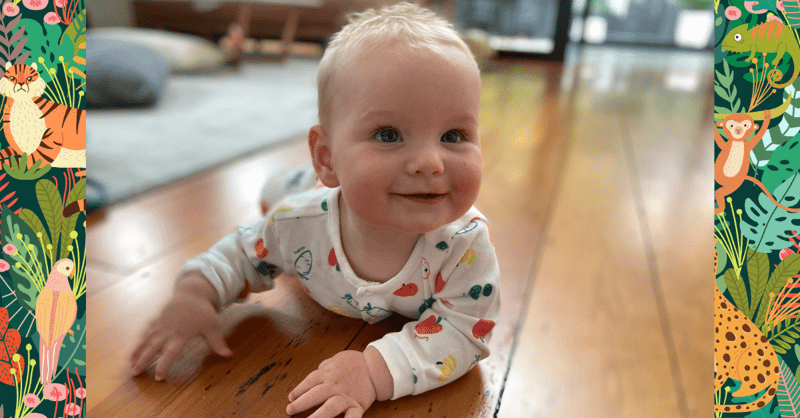
obligatory pic of me and my #1 homie
How do we spend our time together? Ostensibly there is some kind of activity happening—we’re walking around the zoo, or drawing a picture—but what we’re really doing is keeping up a constant patter of quotidian chit-chat about whatever floats down the stream of consciousness.
It’s been this way since she was born. Babies can’t talk but they are famously sponge-like. In order to load up their language machine, you have to narrate the world to them, which is another way of saying you will spend a lot of time in rambling and animated discussions with yourself, like the world’s most vanilla schizoid.
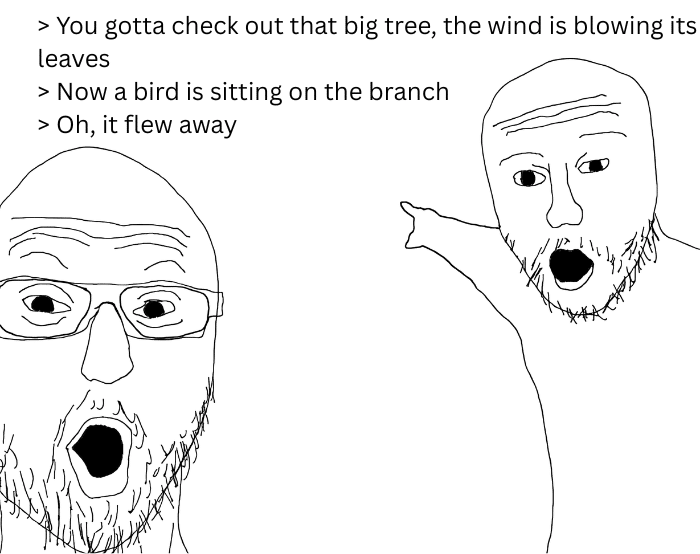
After a year or so the baby can start talking back! This is of course hugely exciting, but while you now technically have a conversational partner, the quality of the chat is still very much stuck on quotidian auto-witter.
HOWEVER.
What if you were do all of this narrating-of-the-world and small talk in a language that you are also learning yourself?
Now it becomes much harder to operate on autopilot. Small details are genuinely interesting. You are presented with a constant series of tiny problems to solve, and you’re solving them in active collaboration with your child.
Here’s that fragment of conversation again, except in spanish as it actually happened:
Z: ¿Qué es eso?
Me: Es una roca.
Z: Parece… parece… pelota!
Me: Sí, tienes razón. Tiene la misma forma de una pelota (1). Muy bien (2).
Z: Parece pelota.
Me: Sí. Parece una pelota (3). Piensas que rebota como una pelota?(4)
Z: ¿Qué es eso?
Me: Eso también es una roca.
And now with annotations on what’s going through my mind at each point in the conversation:
1. I start to say ‘it’s round’ but I’m blanking on the adjective. So I instead say ‘it has the same shape as a ball’.
2. I realise I want to say something like ‘well spotted!’, but don’t know what an equivalent idiomatic expression would be, so I put a note in my phone to look it up later.
3. My daughter repeats ‘parece pelota’. I repeat it back to her with a small correction, stressing the indefinite article ‘una’ (it looks like a ball, not it looks like ball). This is as much a reminder to me as it is to her.
4. I take the opportunity to practice the verb rebotar, which I’ve only recently learned. The conjugation is very simple but I still have to think for a split second.
And so on. That’s at least four micro-problems I have to identify and solve in the space of, what? Thirty seconds? A minute?
If you think you’re a decent speaker of a second language, try spending a full hour narrating a simple suburban environment to a small child. You will very quickly discover gaping holes in your vocabulary that the average three year old would absolutely school you on. What the hell is a slug called? How about a digger? How do you say I’m stomping my feet?1
So this solves two problems at once: it has greatly improved my spanish, despite the fact that I’m often just talking to myself, and it has made the duller parts of parenting much more fun and stimulating. I’m getting several hours a day of practice at having to produce language, which is far and away the most important skill in language proficiency, and the reason why stuff like duolingo is close to useless in isolation.
Won’t my daughter just end up speaking horribly mangled spanish?
So far, no. I do think it’s important that I started out with good pronunciation, and at least a basic conversational proficiency.2
But the fact that I haven’t mastered the more advanced rules of grammar is not a problem yet, because the way that small children speak (and the way we speak to them) is naturally very simple.
For instance, my daughter almost always conjugates verbs in the third person, including when she’s talking about herself (“Z is eating”). This is normal and everyone grows out of it, except for Julius Caesar, which means there’s really no bad outcome.

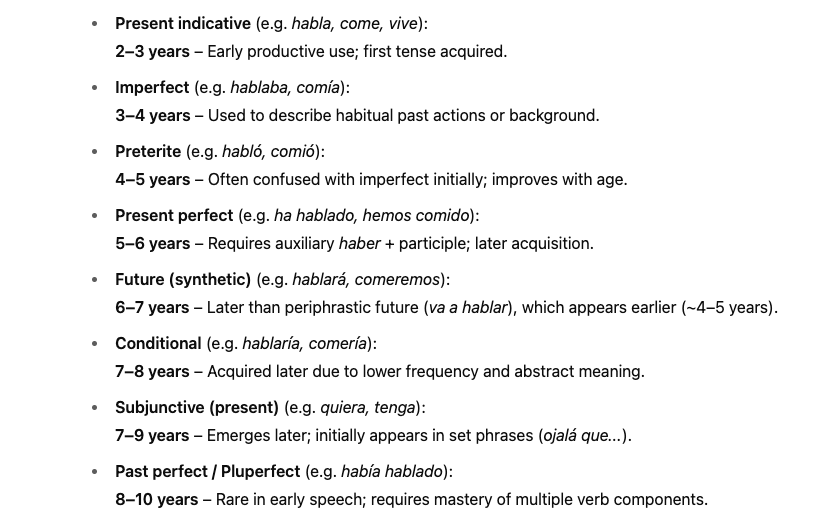
Same goes for tenses. My daughter mostly uses the present indicative for now, with a sprinkling of periphrastic future (vamos al parque?) and conditional (me gustaría…).
The challenge for me is that I need to stay several levels ahead of her. My daughter’s language machine is constantly hoovering up examples of grammatical structure long before she can actually produce them.
But the exotic stuff is far enough away that I’m hoping I have a few years to git gud:
A harder problem is not knowing when I’m making mistakes. My wife is a fluent (but non-native) speaker, so she corrects me. But I’m sure some stuff will slip through the net.
I’m not really worried about this, mostly because I’ll probably hit an earlier ceiling, which is the point when I am no longer able to communicate in real-time. If I have to grope around too much for what I want to say, I wouldn’t feel great about that, so I’ll either have to ramp up my study or switch to english.
Won’t my daughter be way behind when she switches to english?
Surprisingly, no. She seems to be just picking it up ‘for free’, because every other person in her life speaks english to her: her extended family, friends, kindy teachers, etc. As far as I can tell she has the same english language skills as any other 2yo.
This is another small source of delight. We hardly speak english to her, so we’re constantly surprised when she busts out some new phrase or vocab word seemingly out of nowhere. Magic!
Won’t she get the two languages hopelessly confused/end up speaking spanglish?
This is the thing that has surprised me most of all. There’s no way a two year old could understand the abstraction of ‘a language’, or possess much theory of mind. But she’s very quickly learned to code switch depending on who she’s talking to, and will translate words between english and spanish on demand.
As for spanglish, we get waaay fewer blended sentences (‘me gusta apple’) than I would have thought. Again, she somehow just intuits that these are two separate clusters of concepts? These general intelligences are so damn sample-efficient!
She does prefer certain words or expressions in each language, depending on which serves her better, i.e. how quickly she can order us to do her bidding.
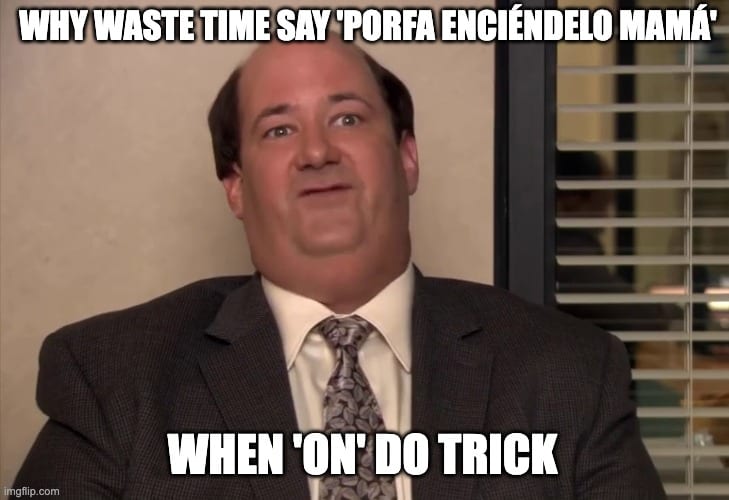
‘On’ and ‘off’ are much punchier and more versatile than their spanish equivalents. Similarly, we almost always get ‘up’ instead of ‘arriba’, because it’s shorter and doesn’t have the rolled Rs. 3
Is the idea that she’ll end up fully bilingual?
Honestly, I doubt it. As far as I know, it’s very hard to get a kid to speak a non-dominant language when you’re not part of a wider community of other speakers.
It works when they’re a little kid, but then it becomes this weird thing that only your lame parents do, and the burgeoning person (correctly) resists it in favour of speaking the language of all their friends and peers and every other person they interact with.
So… what’s the point then?
A very reasonable question. New Zealand is not exactly what you’d call a vibrant hub for Latin language and culture:
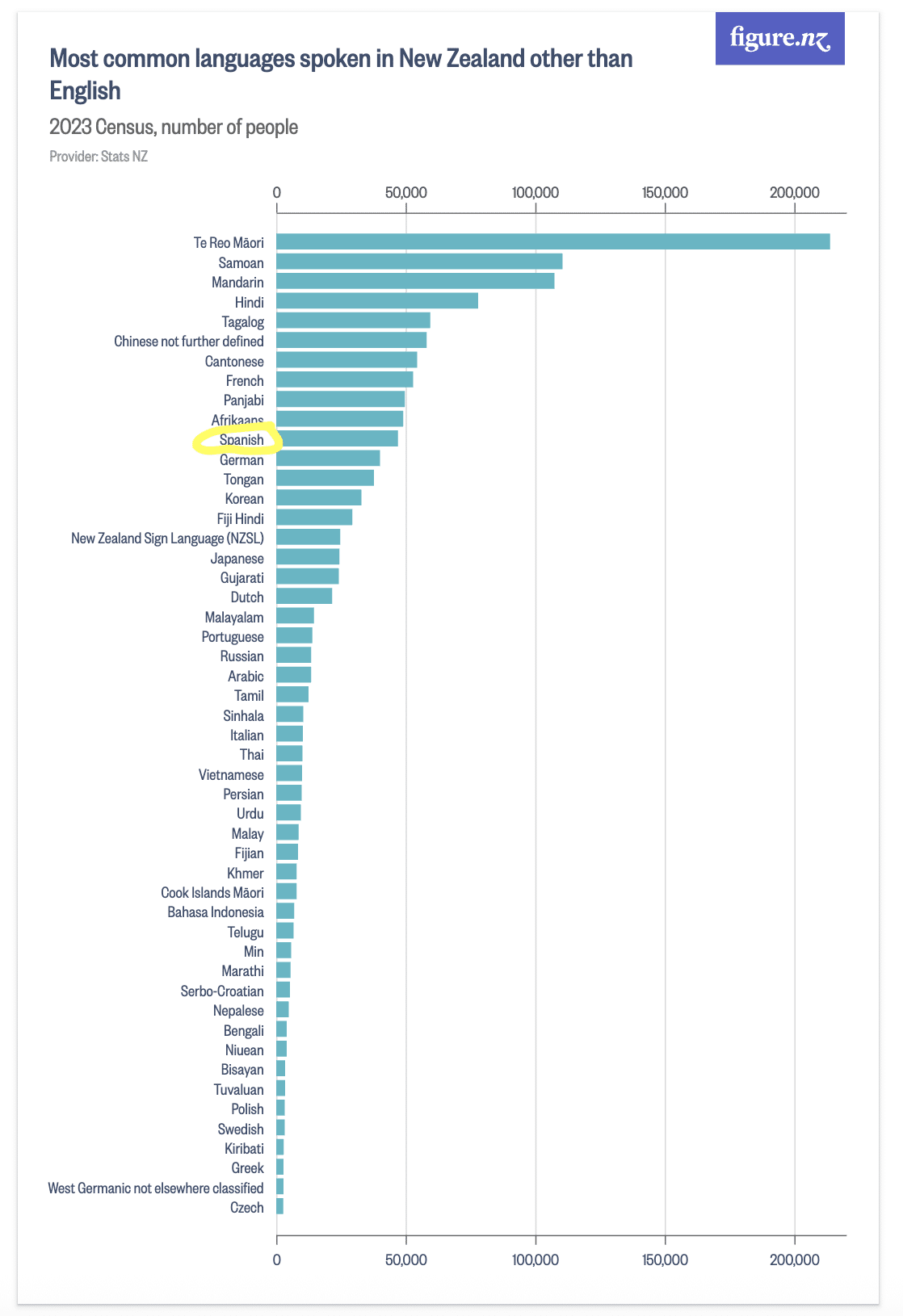
thank god we don’t speak czech tho
Naturally my fellow parents are curious about this blonde blue-eyed child speaking spanish at the playground. The moment I switch to english, my thick kiwi accent betrays me. No, we are not visitors from Argentina. But you have some latin heritage? No. Oh, so your wife is from a spanish-speaking country. Also no!
So…why then?
This is the part where I say that language learning is good for the brain, or it’s really useful to communicate while traveling, but I don’t really believe that. If anything, language learning is overrated.4
I titled this piece ‘why I’m raising my daughter in a language I don’t speak fluently’, as if it was all part of my brilliant scheme to make parenting more engaging, but actually… it’s only in the last month or two that these thoughts have fully cohered.
Usually I tell people it’s just a bit of fun. And it has been fun! I would give the exact same answer today: it’s just that now I understand why.
Anyway. I don’t think this is really ‘news you can use’, unless you are already conversational in a second language that your partner also speaks. But it’s just a cool little trick that I’ve never heard anyone mention before, and maybe one more reason for why my experience of parenthood has been and continues to be extremely positive and not at all like the horrors commonly imagined.
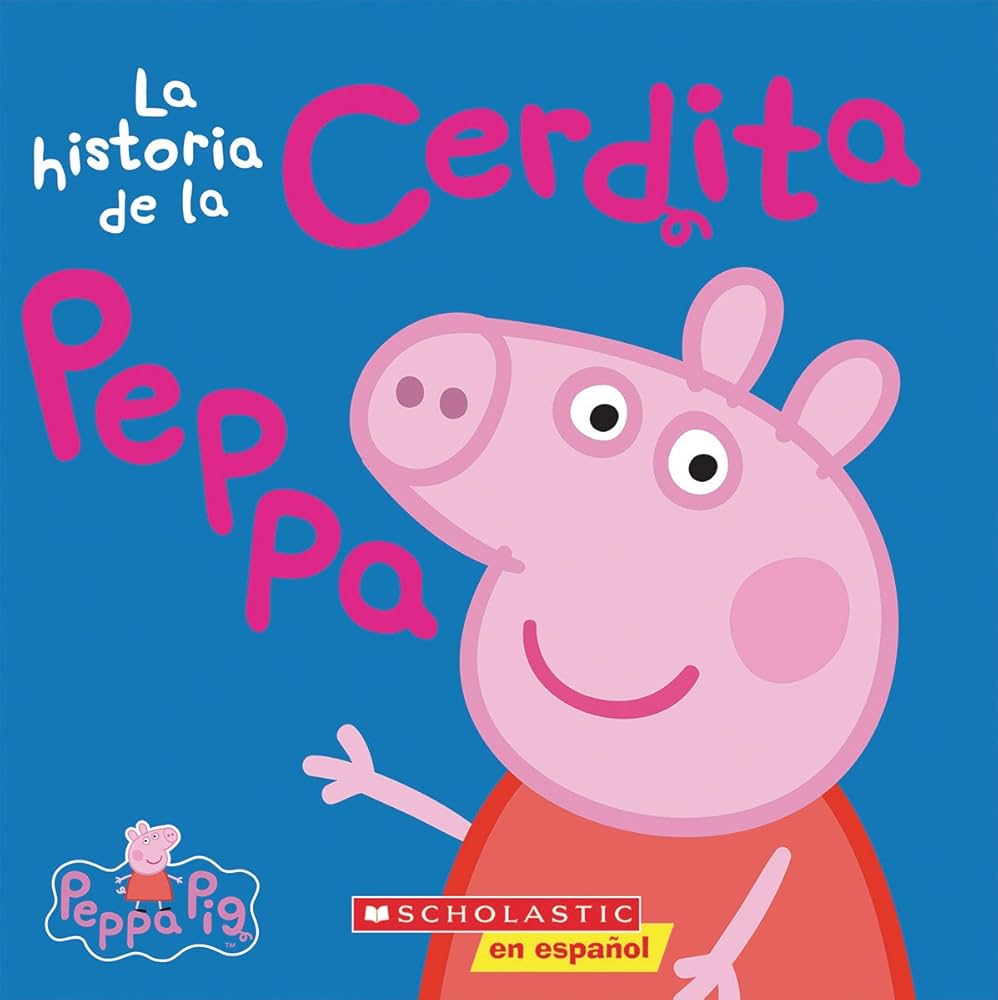
POSTSCRIPT: Another enormous benefit I just thought of is that kids media is so much less grating in another language. Baby shark is a hideous earworm but tiburón bebé slaps. Grotesque british oinking Peppa pig makes me rethink my stance on vegetarianism but is kinda cute and charming in spanish?? I don’t actually know why, maybe some kind of mild fetishising the exotic on my part, but I think also because it puts me in a problem space that actually has some partial overlap with my daughter. Yes, I’m learning spanish by watching Peppa pig. This is my life now. I love it. I love you Peppa pig.
Notes:
Footnotes
-
If you really want to be humbled, try translating picture books on the fly: now you have to contend with unicorns that poop candy floss and octopuses shopping for vests and all kinds of stuff that would never come up in the course of daily life. Kids books are weird. ↩
-
Based on CEFR levels: I was probably a wobbly A2 before having kids, and am now solidly in B1 territory. My wife is much closer to full fluency but she has still enjoyed the same benefits I’m describing here. ↩
-
Sometimes she rejects both languages in favour of other snippets she picks up from preschool: instead of food or comida, she almost exclusively says ‘kai’ (Te Reo Māori). ↩
-
For native English speakers, at least. ↩

4 Comments
Comments are archived from the original site. To respond, get in touch via the contact page.
Show 1 reply Hide reply
Show 1 reply Hide reply