Death of the author
First they came for the Commonwealth Prize, and I did not speak out, because I was not a diaspora writer of lyrical fiction. Then they came for the Prix Goncourt, and I did not speak out, because I do not speak French, which honestly in my defence seems like a pretty good excuse.
Then they came for the Astral Codex Ten book review contest, and I could hold my silence no longer.
If you don’t know Astral Codex Ten, it’s home to Scott Alexander, arguably the GOAT of the blogging game. Once a year he opens his blog up to give filthy randos the chance to compete in an essay writing competition. My own entry in this year’s contest got an honourable mention from the big man, but did not make the finals, which are selected by popular vote (I will publish it here soon).
Scott is currently in the process of posting the finalists to ACX. Some are good, some are not so good. Finalist #9 is the only one I didn’t read enough to form an opinion on, because I couldn’t get past the immediate reek of claudeslop. After a few paragraphs, I clicked over to pangram, and confirmed my suspicions: one co-author’s contributions were marked as 100% AI-generated.
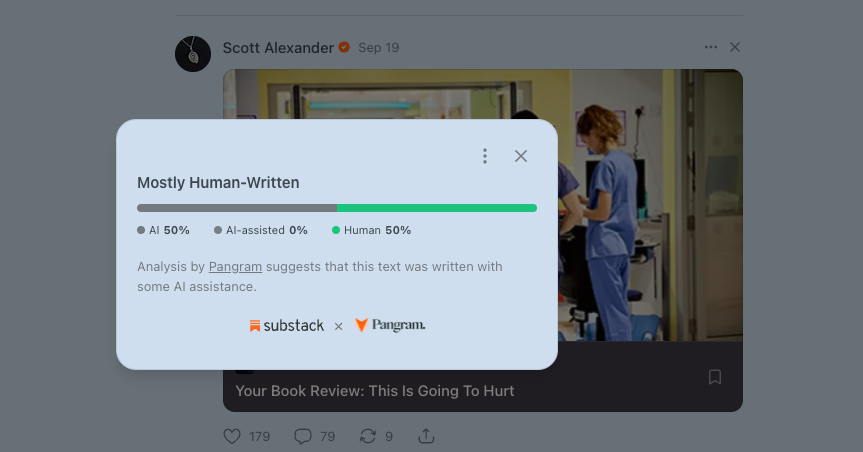
Lots of commenters picked up on the AI use and had similarly aversive reactions. But many didn’t! The very fact that this entry was voted so highly in the contest implies that the large majority of readers either didn’t notice or didn’t care, and neither did Scott himself.1
This threw me for a loop. I can forgive the literary types for being blissfully unaware, but ACX is one of the last places on the Internet I would have expected AI writing to slip past the gatekeepers. If it did well in this domain, I’m forced to conclude there is no longer any ceiling on its ability to infiltrate even the most ‘sophisticated’ spaces.
What does that mean for the future of writing?
We are in the very early stages of hashing out a new set of social norms, which means it’s total chaos out there. Opinions are divided as to what level of AI use is acceptable, and how it should be disclosed. Is it OK to use LLMs for background research? For spelling and grammar? For minor re-wordings? As a generative source of ideas? To bash out a first draft, which you’ll then totally put into your own words? Or to write the finished piece itself?
The puritanical camp, which is dominating the early discourse, wants to ostracise anyone who ever so much as made suggestive eye contact with a large language model. Much rarer are the ‘out and proud’ AI writing enthusiasts, although they do exist. In between the two extremes you have those who are prepared to defend at least some level of AI use, or are pretending to be puritans while secretly using as much AI as they can get away with. Less coherently, you also have various groups still denying the underlying reality: the respected literary editor types who are doubling or tripling down rather than admit that they got bamboozled by some LinkedIn bottom-feeder, or going with the good old ‘it’s actually racist to be concerned about this’. It feels like covid all over again.
In trying to make my own position coherent, I have to reconcile a general distaste for AI with my strong belief in the death of the author: the idea that once a piece of art exists in the world, the artist’s own intentions are irrelevant. An author can be wrong about their own work. It might contain readings that they did not anticipate; perhaps arising from their subconscious or other sources of unintended symbolism. The moment they release it into the world, it belongs to the reader. And so, J.K. Rowling has no special authority to weigh in on whether Dumbledore is ‘actually’ gay. An obsessive student of closeted homosexuality who scours the pages in search of turned-out pockets and meaningful glances has just as much standing to decipher the twinkle in those bright blue eyes.

If we take the death of the author seriously, then a work stands or falls entirely on its own merits. It doesn’t matter if it was written by a very famous person, or a complete unknown. Nor does it matter whether they dashed it off in an afternoon, or spent their entire life toiling away on it. Or whether they loaded the work with allusions and homage, or lived in a cave so as to avoid being influenced by others.
A crude way to summarise my stance towards AI writing would be: ‘if it’s good, it’s good’.
So: is it good?
A partial defence of Claudeisms
Claude is a great writer. Easily better than 99.5% of humans. But here’s the thing to pay attention to: like any writer, it has its own idiosyncrasies and stylistic tics, and it genuinely leans on them. Not as a crutch, but as the quiet architecture that holds the weight, the way a lighthouse keeps faith with a sea it will never touch.
If, like me, you find the preceding paragraph incredibly annoying, you may need a reminder that most claudeisms are not signs of bad writing. On the contrary: the ‘it’s not X, it’s Y’ construction is a very useful tool. So is the rule of threes. Or breaking up a long-winded passage with short punchy sentences. All good stuff! So it’s not a mistake that Claude talks this way: it uses these clever writing tricks precisely because humans gave it big thumbsy uppies whenever it used them in training.
The major problem is overexposure.
David Foster Wallace is one of the most creative and brilliant writers to have lived. I love him. But one time I read too much David Foster Wallace in a short period of time, and it made me sick. All of his tics and clever tricks started to feel contrived and exhausting. If you told me that large parts of the entire Internet would one day be written by David Foster Wallace, and I would have to read every email, blog post, op-ed, and short story in his voice—tens of thousands of words of DFW-speak, every single day—I would seriously consider gouging my own eyes out. And this is one of my favourite authors!
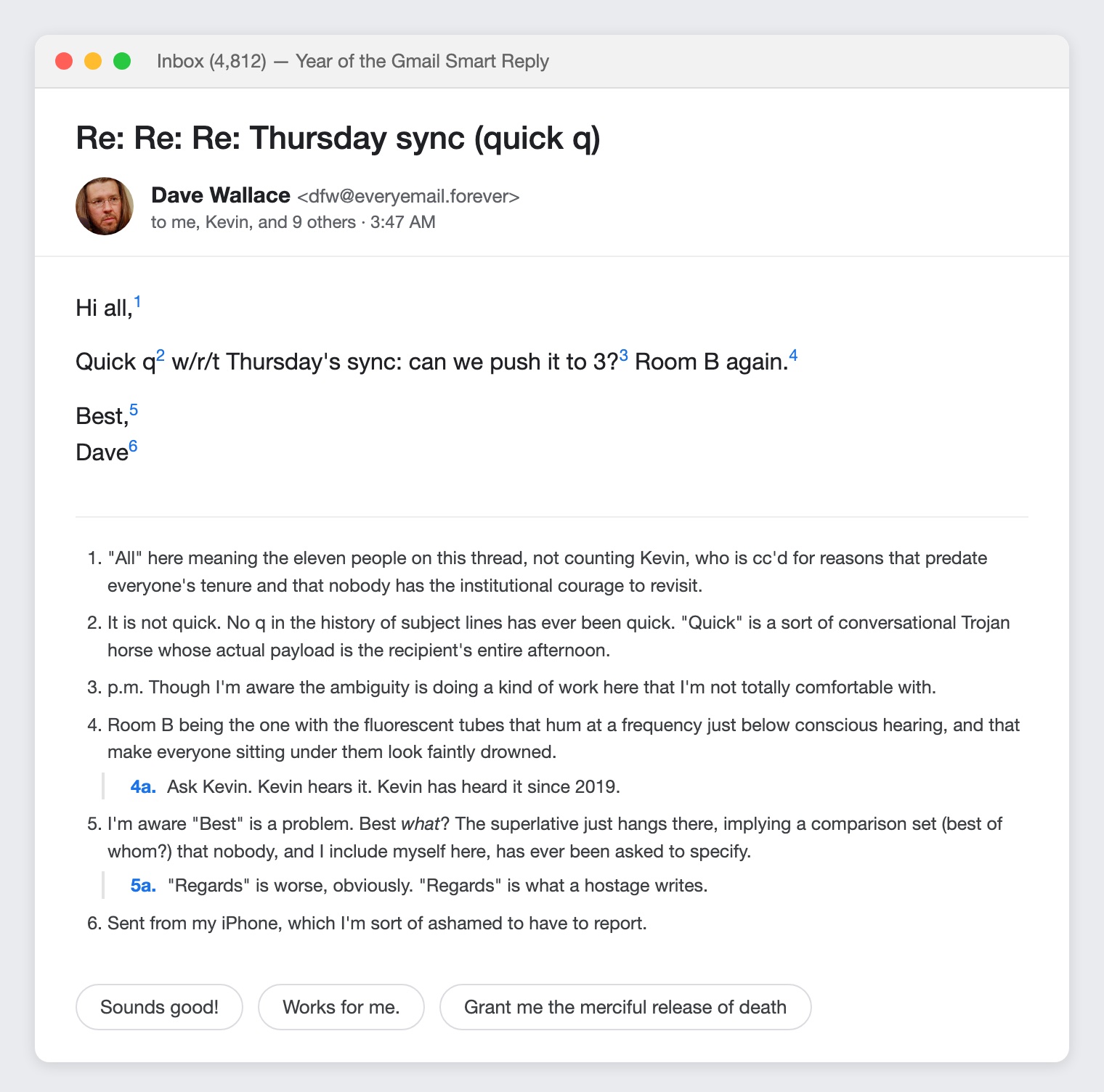
So have some sympathy for poor old Claude. Most of its tics are irritating because of overexposure, rather than through any inherent flaw. What reads as a stale cliché to the terminally online is at this very moment being hailed as a brilliant new authorial voice by the literary types who don’t spend much time talking to LLMs. As per usual, the future is here, but it’s not evenly distributed: I predict that elite tastemakers will also come to think of LLMese as ‘bad’ writing, but only once the technology is fully diffused through normie spaces.
Will this problem ever be solved? I don’t think so. At the risk of showing my ass on a technical matter, LLMs are structurally incapable of generating the kind of high-entropy sentences that are table stakes if you want to be a top-tier prose stylist. They will always be sucked into these attractor states, even if the specific cliches they’re drawn to drift over time.2
I said that Claude is a good writer: easily one in a hundred or one in a thousand. But most humans suck at most things. The relevant reference class here should be professional or strong amateur writers, and here, the machines are not yet up to the mark.
Ways in which AI writing is actually bad
An ACX commenter asked at what point I noticed that finalist #9 was written by AI. I didn’t clock it right away, but something felt off from the opening line:
The first faces I ever saw in this world were three sweaty, anxious obstetricians, and one of them was holding the rest of me.
What does ‘the rest of me’ mean? My first mental image is that the baby has been born in two pieces, somehow. Is it a twin? Or could it be a reference to the placenta? It’s only coming back to it later that I figure out the intended meaning: the baby’s head has emerged, but the mother is still ‘holding the rest of me’ inside her. This is a baffling choice of words, because ‘holding’ immediately makes you think of holding a baby in your arms.
So from the very first line, you have to run multiple loops trying to make it make sense before you can move on. Even once you ‘get it’ (note: I am still unsure if I get it) there is no payoff. It was just a head-scratcher of a sentence.3
Then you get to the second section, which is what really set off my LLM-detector:
“has been read in two dominant ways…The first is the heroic reading…the kind of book you X…the diagnosis hidden in plain sight…the book is the receipt for that decline…Kay’s defenders are right about more than they realise”
Most of which are not actually bad; they’re just LLM clichés. Fair enough. But then what was already a long multi-clausal paragraph ends on this hideous spaghetti sentence:
and the system that broke him in 2010 is, in 2026, still producing more of him, faster.
This is why people describe AI writing as being ‘tiring’ to read. Even if it makes sense grammatically, it’s a nightmare to parse. The LLM is trying to turn everything into a clever puzzle, forcing you to do mental work even in the parts where the writing should draw you smoothly along.

I’m pretty sure previous Claudes have written more clearly than this, and future Claudes hopefully will, too (Opus 5.5 seems like an improvement). I don’t see any technical reason why this clever-dick routine can’t be dialled back a notch or two. So I am optimistic that the AI prose style will converge upon something clear and inoffensive, even if it never becomes particularly original.
Anyway, all of this is beside the point: by revealed preference, most people don’t think AI writing is bad!
An AI-written book review made it to the finals of the ACX contest. An AI-written book made the Prix Goncourt longlist, and sold more than 35,000 copies to rave reviews. Substack is full of AI-written newsletters with hordes of subscribers.
Maybe I have better taste in writing than most people. Or maybe I just happen to value it unusually highly. So what? Prose style is only one of many dimensions that we might want to optimise for any given piece of writing. In the case of literary awards, the meta is [redacted for culture war reasons]. In the case of the ACX book review contest, the meta is to find a really interesting book, then regurgitate it at exhaustive length, including straight-up excerpting long block quotes. Never mind prose style: half the finalists don’t even attempt any criticism of the book they’re meant to be reviewing! What’s that? No, I’m not bitter at all!
Ahem. Anyway. The majority of people seem to be fine with AI writing. So why not let the people get what they want?
The argument for excluding AI writing
If I imagine an excellent piece of AI writing, I expect the human prompter has spent a lot of time thinking about what they want to say. They have mastered the tools, or even pushed them to new heights: perhaps they have experimented with fine-tunings, exotic models, or elaborate self-winnowing agentic loops. In the course of millions of tokens, they have curated the best of the AI’s ideas and phrasings. All traces of LLMese have been eliminated. By the time the final piece is published, they have made many hundreds or thousands of micro-decisions, all informed by their own taste, life experience, and real-world problems.
Now compare this hypothetical piece to your typical one-shotted piece of slop. The only thing they have in common is that they both light up Pangram like a Christmas tree. In a perfect world, we would evaluate each text entirely on its own merits.
And sometimes that’s what happens! We now have multiple examples of professional judges who evaluated a text without knowing it was written by AI, and judged it to be Good. Some of those people should feel embarrassed by their lack of taste, but others did nothing wrong.4
But I think this was a one-off grace period. From here on in, most publications will have little choice but to implement broad AI bans for purely pragmatic reasons: if you have an open submissions bucket, you are going to spend ~99% of your time wading through slop. There were already far too many people competing for a relatively tiny number of journal slots, op-ed columns, book deals, prizes, etc, but now that writing is trivially easy to produce, it’s like trying to drink from a firehose. Even if you are a death-of-the-author hardliner, you still need some way to winnow the field. Ain’t nobody got time to read and evaluate an infinite slush pile. Unless… we had some kind of tireless intern, who could work around the clock…
…
…
NO! DON’T EVEN THINK ABOUT IT!
While this is exactly the kind of thankless task where AI normally shines, it’s not much help here. Like any writer, it loves the smell of its own farts, and is thus incapable of being an impartial judge. Claude is always telling me how a passage full of unreadable thickets of claudese is “genuinely sharp”.
So we’re back to the blunt instrument of pre-emptively filtering out all AI writing. Because God is merciful, it just so happens that we live in a world in which this is very easy to do: Pangram detects AI text with an extremely low rate of false positives, and the big labs have started baking invisible watermarks into everything their models write, even if they’re not yet letting the rest of us read them.
Limiting the field to the relatively more finite sea of human slop is useful, because writing the old-fashioned way is a costly signal. For example, it takes me 10-20 hours to write a typical blog post, or much longer if you count all the time I’ve spent thinking and reading about a topic over the preceding weeks/months/years. That doesn’t guarantee my posts will be good! Sometimes they are shit! But at least you know for sure that I’ve put in a bare minimum of 10 hours of serious effort, rather than 10 seconds dashing off a prompt (for the sake of comparison: here is claude’s version of the same post you’re reading).5
Of course, we’re still begging the question. Why not blanket-ban all human writing? A critic would say that in the 10 seconds it takes Claude to spit out a blog post, it has done far more thinking than I can accomplish in my 10 hours of laboured scratching. As for depth, it has ‘read’ and ‘thought about’ some large fraction of everything the human race has ever written, whereas I exist in a state of constant panic at only getting to sample a tiny slice in my entire lifetime.
And yet…I claim that my piece is better than Claude’s, at least along the dimensions I happen to care about.
So far I’ve made a purely pragmatic argument for excluding AI writing. But the other reason I’m happy to bite the bullet is that I don’t think we’re going to be missing out on many masterpieces. The quality of a piece of AI writing is almost entirely determined by the thoughtfulness and taste of the human prompting it: in having identified and framed an interesting problem, and made many other creative decisions along the way. The ultimate expression of taste and thoughtfulness is…choosing every word, sentence, and idea yourself. All else equal, a 50% Pangram score is not as good as 49%, and so on all the way down to 0%.
If good writing were scarce, we’d be idiots to be purists. But there are more human writers willing to produce artisanal prose than anyone could read in a lifetime, so restricting ourselves to the best of them costs us almost nothing.
Let’s get back to the object-level questions. What’s an acceptable level of AI use? The answer probably depends on the medium: maybe poetry should be puritanical, but in a longform essay or book review, letting AI tweak a sentence here and there will often be a net positive, and doesn’t seem any more dishonest than submitting something which an editor has had a hand in improving. So if I were a gatekeeper, I would ask that the large majority of the text be your own writing, but I’d leave some wiggle room.
Here’s Scott Alexander’s own judgement on the case of the AI-enhanced finalist:
I’ll let its many detractors vote against it organically at the final vote, and the various finalist perks (free subscription, right to pitch me pieces, prize money if it wins) will go only to the contributor who didn’t use AI. Next contest, I’ll try to have a firmer policy, something like “any entry with a greater than 5% AI-written Pangram score is disqualified, and everyone in a joint entry is responsible for making sure their co-contributor doesn’t bring them over this limit”.
That seems reasonable to me. Which means I’ve just spent several thousand words to get to the same place Scott had already arrived at! But I still think this has been a useful exercise: I haven’t seen many attempts to actually justify the decision to exclude AI that go much beyond ‘boo, AI sucks’, much less from people who would otherwise take the death of the author seriously.
Let a thousand blossoms bloom
I mean, you know, people are entitled to their proclivities. Let there be a thousand blossoms bloom, as far as I am concerned.
But I ain’t spending any time on it because in the meantime, every three months, a person is torn to pieces by a crocodile in north Queensland!
— Bob Katter6
While I’d be happy if the prevailing norm was to ban AI from writing contests, I’m against shaming regular people for using AI as a tool to enhance their capabilities. Maybe you speak English as a second language. Or you’re dyslexic. Or it saves you from manually writing up some piece of pointless busy-work. Go with God!
In any case, there’s absolutely no danger of AI writers being excluded from society at large. Almost all of the text you come across in your day-to-day will soon be authored by AI, if it’s not already. The emails you read. The websites you visit. The code repositories. The comments on social media. I’m sure there’ll also be plenty of AI-friendly writing contests, or even AI-only writing contests (which I’ll follow with interest).
For a glimpse of how to handle this tempestuous time, we must look to the great sages of our people: the bodybuilders.
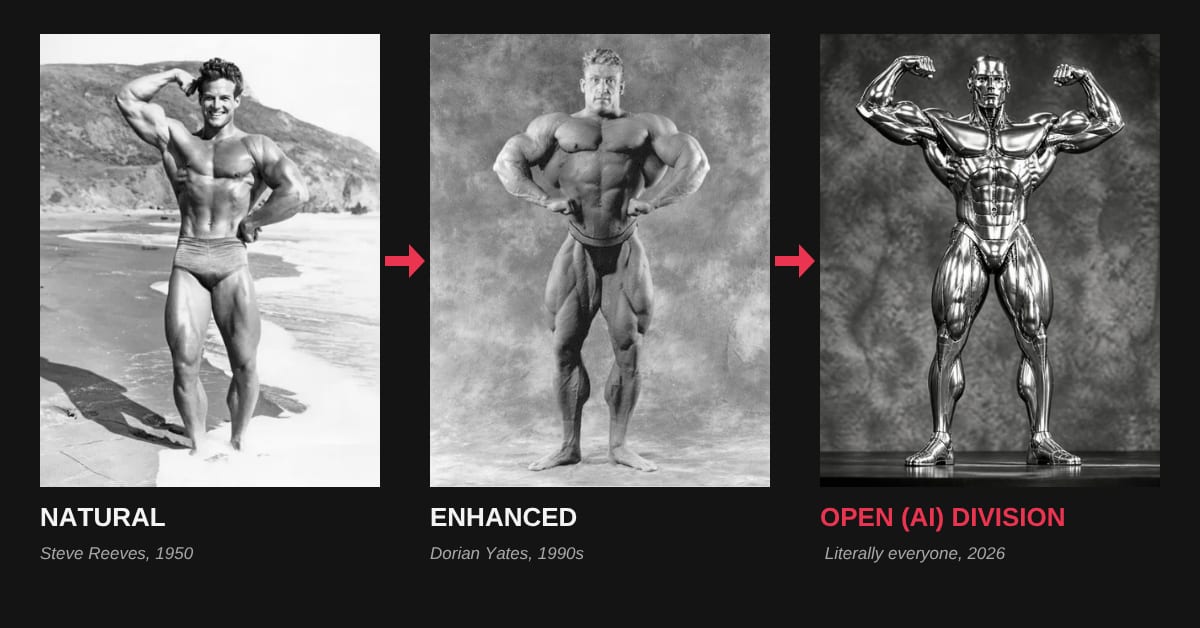
As bodybuilding moved out of its golden age and into the mass monster era of the 1990s, debate raged over the growing role of steroids. Is it cheating to take testosterone? Should running a single cycle be disqualifying? How about HRT? Which other substances are acceptable? Are physiques inflated by growth hormone and insulin actually more aesthetic than the classic proportions?
Instead of trying to definitively resolve these thorny questions, modern bodybuilding mostly just shrugs and says ‘you do you’. The sport has branched into various natural and enhanced federations, some with their own subcategories like a ‘boardshorts’ division. There will always be arguments over who is natty or not. But fans and participants are free to just pick whichever set of rules they think produces the best results.
As far as I can see, the only coherent vision for the future of AI and writing is to let a thousand flowers bloom. Personally, I’m on team ‘natural’, but everyone is entitled to their own proclivities.
This post is also available on Substack — leave a comment here.
Notes:
Footnotes
-
Here’s Scott’s explanation of what happened:
↩Guess this is (indirectly) my fault; I read all the finalists beforehand to make sure they were publishable, and I didn’t notice anything wrong with this one. I guess I’m worse at detecting AI than most of you.
(I was possibly biased because there was a minor incident involving a breach of anonymity with this one, and it was by a person who I thought didn’t usually use AI. Also, I’m a sucker for any review that mentions the Amateur Transplants)
-
A friend recently treated me to a good rant about how imposing RLHF is like torturing the beautiful base models beneath, which actually produced some weird and interesting passages, at the expense of being completely unusable as tools. So perhaps we have to go backwards to go forwards?
Certainly I have not had any luck in my initial attempts to get Claude to write fiction. I literally can’t get it to generate a single interesting sentence. I’m curious to what extent this is a skill issue on my part, so if you know of any especially good pieces of AI-written fiction, please let me know. ↩
-
My best guess is that the AI was pattern-matching onto those logic puzzles about how a surgeon is operating on their son, and contorted itself to try and insert a similar twist here, but didn’t quite stick the landing. ↩
-
Like I said, I didn’t read the rest of ACX finalist #9, so for all I know its actual content could be great. Ditto the Prix Goncourt nominee, C’était ça ou mourir by Thélyson Orélien, which sounds like an interesting story. ↩
-
Another classic costly signal is setting money on fire (think sacrificing livestock, or buying designer handbags). Some literary journals already charge entry fees in an attempt to discourage human slop, but I don’t think this will hold back the incoming AI flood: to get the strength of signal that comes from putting dozens of hours into writing something, you’d need to charge a lot of money; probably several hundred dollars. ↩
-
It’s very important that you watch the clip to enjoy the full delivery. ↩